What the card says
An editorial summary of the readable passages, rather than a complete translation of every sign. The sender remains unidentified; the nickname and similar language across cards do not establish a single writer.
The phrase about a dear letter crossing a note sent to zirovnice has a connected Czech grammatical frame. Žirovnice is the proposed place-name reading after capitalization and diacritics. A following first-person promise to answer as soon as possible gives the passage substance beyond its greeting and closing.
The message returns wishes for happy and merry holidays. The text itself does not identify a particular holiday. Its affectionate closing has a partly unresolved nickname.
Saved literal readings
This is the saved decoding output. Question marks mark unresolved source units, which may be single letters, digraphs or uncertain groupings of strokes. Spelling defects, line breaks and source-region labels are preserved; proposed corrections are discussed separately.
First fixed-key literal (23 entries)
?isicery dik zla?o moje za
drahy dopis kri?oval se s mym
?istkem do zirovnice zasla
nym budu?en?okra?e hod
n?jsim a odpovim ?i co nej
dri ve preje ?i navzajem
rovnez s?astn? a vesele svatky
liba ?e v ??chu mescislnekra?e
vecne ?vuj pepou?
Later post-test learned-t replay (24 entries)
tisicery dik zlato moje za
drahy dopis kri?oval se s mym
?istkem do zirovnice zasla
nym budu?entokrate hod
n?jsim a odpovim ti co nej
dri ve preje ti navzajem
rovnez stastn? a vesele svatky
liba te v ??chu mescislnekrate
vecne tvuj pepou?
What remains uncertain
- The second literal is a post-test learned replay. It is not a new held-out test and does not replace the first 178/196 result.
- Before this card was selected as a held-out target, preliminary source inspection had already noted opening and closing symbol sequences shared with card 441. The interior correspondence passages therefore provide the stronger independent evidence.
- The first literal mescislnekra?e and the later mescislnekrate remain malformed. The proposed sense “countless times” requires changing resolved m to n as well as editorial diacritics; it is not an accepted correction.
- The closing pepou? retains an unknown final source unit in both outputs.
Source and method
First fixed-23-entry-key test, followed by a disclosed post-test learned extension.
First prediction: 178/196 mapped. Later learned-t replay: 188/196; this later increase is not independent validation.
HCPortal catalogue record for card 440 · Open the original photograph
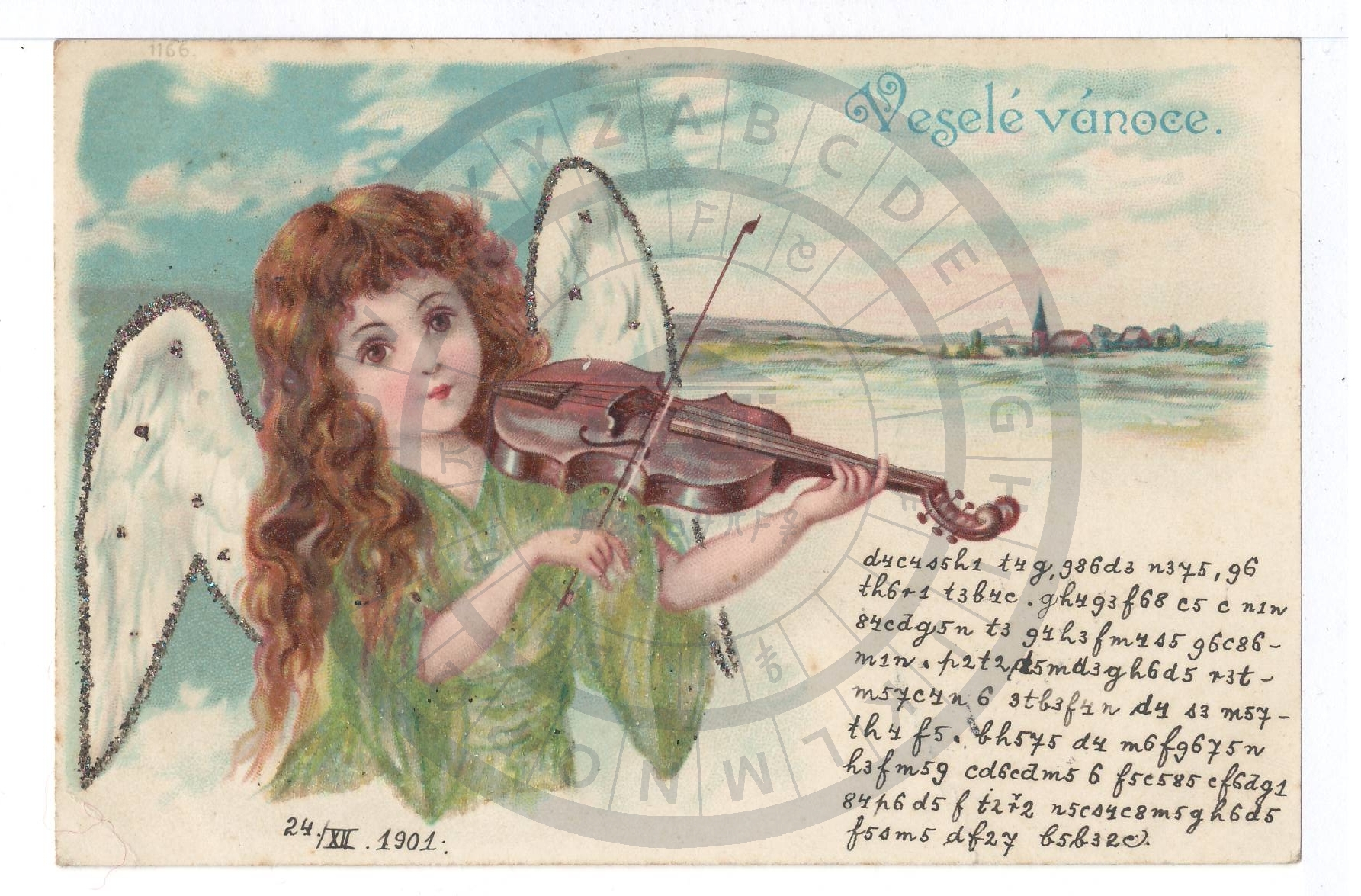
24 December 1901 · inscribed date. The date label records its evidence source; it does not establish a posting or receipt date.
The first result used the 23 assignments developed before this card was decoded. A later replay added one learned mapping for an unbarred form of t, raising coverage from 178 to 188 of 196 source positions. Both outputs are shown so that the improvement is not mistaken for part of the original prediction.
The source transcriptions and language checks were AI-generated. No external human expert review is claimed. Coverage counts signs assigned a value, not verified correct letters; one sign can produce the two-letter Czech ch.
Evidence and context
- Original study: development and fixed-key testing
- First-edition partial key and staged mark rules
- Official HCPortal catalogue record: pc_hcp_440
- Official HCPortal picture-side source image
- First fixed-key literal (23 entries) — exact text download
- Later post-test learned-t replay (24 entries) — exact text download
Editorial revision, 5 October 2026: the explanation has been reorganized and repeated cautions shortened. Saved Czech outputs, numerical results and source links are unchanged. Photographs remain linked at their source.