What the card says
An editorial summary of the readable passages, rather than a complete translation of every sign. The sender remains unidentified; the nickname and similar language across cards do not establish a single writer.
The message wishes the addressee the best for the New Year, especially the fulfillment of her wishes. It then appears to ask whether she will love the writer in the New Year as before. A thousand kisses and vecne tvuj pepous form the affectionate signoff.
The final passage asks, in the proposed reading, whether a note was received on Sunday. The broken place expression v pel / ?rimo?e is compatible with v Pelhřimově, “in Pelhřimov,” but that identification remains an editorial completion.
Saved literal readings
This is the saved decoding output. Question marks mark unresolved source units, which may be single letters, digraphs or uncertain groupings of strokes. Spelling defects, line breaks and source-region labels are preserved; proposed corrections are discussed separately.
First fixed-key literal
?reji ?i anisko noje vrele milovana z
u ?rimneho sr?ecka st?le jen na tebe vzpo
?inajiciho vse nejhezci k novemu roku
zejmena pak splneni v?skerych p?ani ?ez
sladka tvoje dus?cka ?ov?
budes mne m?ti drahousku v novem roce zase
?a k rada jako ?osud tisic pus posila ti
vecne tvuj pepous
obdr?ela jsi v nedeli muj listek v pel
?rimo?e
What remains uncertain
- The newly learned unbarred t form is absent from this card. Although the 24-entry table was applied unchanged, this card does not test that 24th assignment.
- The opening noje is preserved. Reading it as moje, “my,” changes an already resolved n to m.
- The affectionate address anisko does not justify silently substituting Aničko; that alternative would change s to c. An affectionate name form does not establish a historical identity.
- The location, question punctuation and several words in a smooth English reading require completion or editorial normalization.
Source and method
Fresh test with the 24-entry key fixed before decoding this card.
First fixed-key prediction: 254 of 272 source positions mapped; 18 remain unknown.
HCPortal catalogue record for card 250 · Open the original photograph
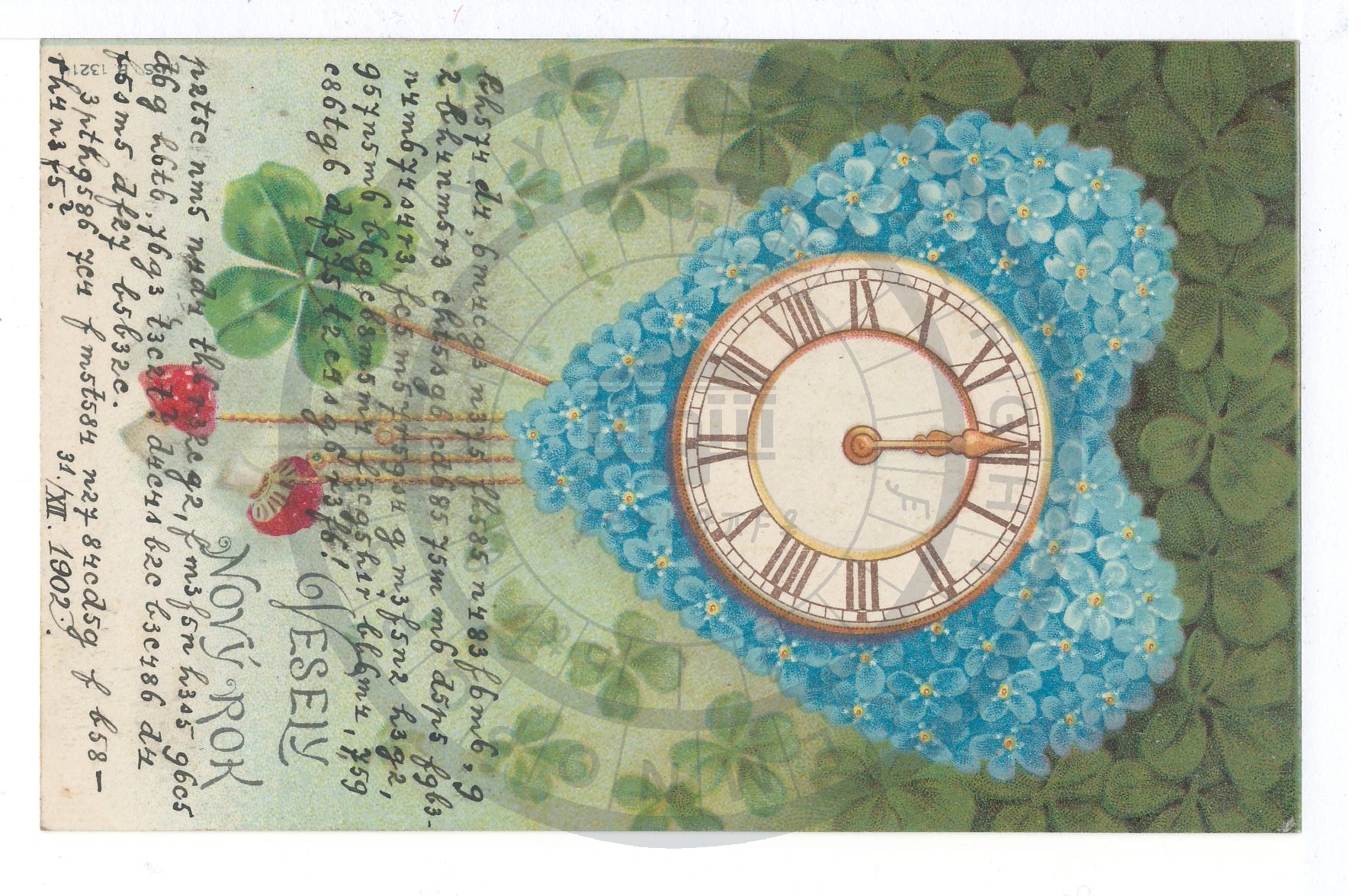
31 December 1902 · inscribed date. The date label records its evidence source; it does not establish a posting or receipt date.
A separate AI reviewer, given only the saved literal, found connected Czech beyond the seasonal greeting. This assesses linguistic plausibility rather than correctness against a known historical plaintext.
The source transcriptions and language checks were AI-generated. No external human expert review is claimed. Coverage counts signs assigned a value, not verified correct letters; one sign can produce the two-letter Czech ch.
Evidence and context
- Original study: development and fixed-key testing
- First-edition partial key and staged mark rules
- Official HCPortal catalogue record: pc_hcp_250
- Official HCPortal picture-side source image
- First fixed-key literal — exact text download
Editorial revision, 5 October 2026: the explanation has been reorganized and repeated cautions shortened. Saved Czech outputs, numerical results and source links are unchanged. Photographs remain linked at their source.