What the card says
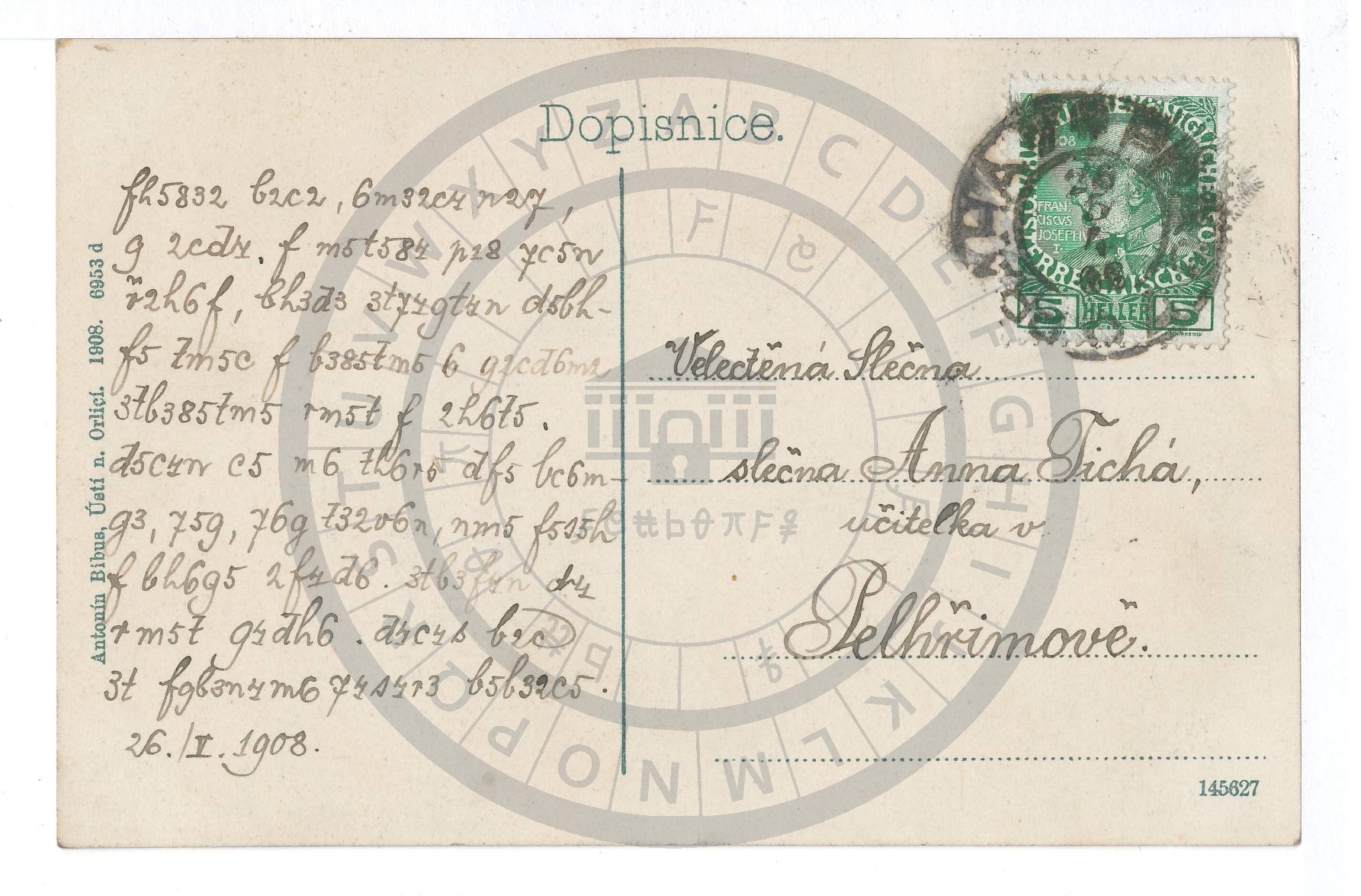
An editorial summary of the readable passages, rather than a complete translation of every sign. The sender remains unidentified; the nickname and similar language across cards do not establish a single writer.
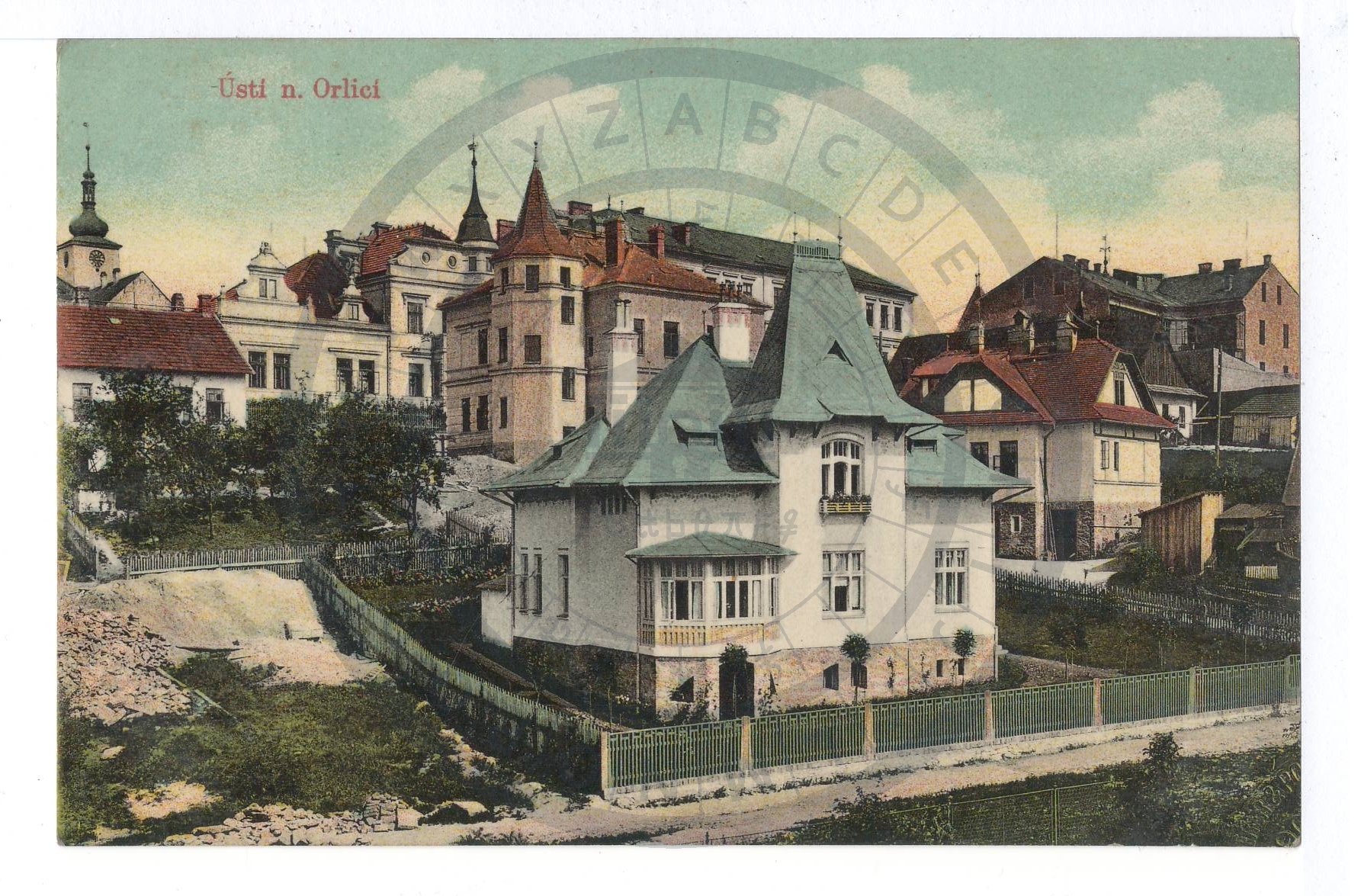
The opening sends a warm kiss to “Anouši,” an affectionate form of address. The following z usti may mean “from Ústí.” The picture’s printed caption reads “Ústí n. Orlicí,” although this does not establish where the writer was.
The partly readable body suggests that the writer was unwell on Sunday and is departing only today at noon. The next clause remains unclear: its central word is ?ystan? in the saved output. A later image review suggests “I will remain,” but that alternative has unresolved signs of its own.
The writer appears to expect a dear note that evening in pra?e, plausibly Prague, and promises to reply tomorrow. The closing contains a remembering or thinking-of phrase and the nickname pepouse. The three unknown signs after tisic may complete “a thousand kisses,” but that remains a conjecture.
Saved literal readings
This is the saved decoding output. Question marks mark unresolved source units, which may be single letters, digraphs or uncertain groupings of strokes. Spelling defects, line breaks and source-region labels are preserved; proposed corrections are discussed separately.
First primary fixed-key literal (secondary output is identical)
vrelou pusu anousi muj
z usti ? ne?eli byl jsem
chura? ?roto o?jiz?im tepr
ve d?es v poledne a ?ystan?
odpoledne hned ? u?ade
tesim se na d?ah? tve ?san
ko jez jak doufam mne ve?er
v pra?e u?ita o?po??m ti
hne? ?i?ra tisic ???
o? vz?omina jiciho pepouse
What remains uncertain
- The central ?ystan? remains unresolved in the first output. Turning it into standard zůstanu would change the already resolved y to u before adding the ring, rather than merely complete unknowns. The later source-compatible alternative has its own unresolved forms and limited confidence; it does not replace the first result.
- The nearby ? u?ade can plausibly refer to an office, but the unresolved verb leaves the action unclear.
- Joining ?san and ko with proposed initial p gives psanko. No letters are inserted to turn it into psaníčko.
- The catalogue dates this card 26 May 1908. Two fresh source-only AI readings agree on day 26 and year 1908 but disagree about the Roman month character: V (May) versus I (January). The written month remains disputed; January is not established. Neither the inscription nor the uncertain cancellation independently establishes a composition, dispatch or receipt date.
Source and method
Fresh test with the unchanged 24-entry key. All 24 established graphical assignments occur; no new assignments, mark transformation or experimental g prediction is exercised.
First fixed-key prediction: 176 of 204 source positions mapped; 28 remain unknown. A separate strict unmarked source-quality subset contains 162 positions; 14 mapped forms retain cautions. Secondary output is byte-identical.
HCPortal catalogue record for card 339
26 May 1908 · catalogue date; written month disputed. The date label records its evidence source; it does not establish a posting or receipt date.
A picture-only inspection completed before decoding read the caption as “Ústí n. Orlicí.” It identified no building or institution. The proposed travel and place readings come from the partly resolved text, not an independently verified itinerary.
A disclosed post-test source audit re-examined that seven-body word without seeing plaintext or prior labels. Its different graphical readings give ?usta?u under the unchanged key, allowing a source-compatible proposal for zůstanu, “I will remain.” The first and sixth bodies still admit alternatives, while the second and final readings have only medium and medium-low visual confidence. This preserves a source disagreement rather than authorizing a certain repair: the saved first output remains ?ystan?.
A separate source-only postal audit supports the partial place letters PRA…. Independent readers disagreed materially about the inner numerals, so the cancellation does not supply a secure complete date, time or year. In particular, 08 is not established as a cancellation year. The postal fragment is not expanded into a city or used to infer a route, residence or postal function.
One unchanged key lookup mapped 176 of 204 positions. All 24 established graphical assignments occur, including one ch unit, so the mapped positions emit 177 letters. The source record separately identifies 162 positions in its strict unmarked quality subset; 14 other assigned forms carry visibility, compactness or marked-form cautions. These counts describe different source properties and do not establish uniform high confidence or historical accuracy. The identical secondary output tests no mark transformation, and no experimental g prediction was generated.
The source transcriptions and language checks were AI-generated. No external human expert review is claimed. Coverage counts signs assigned a value, not verified correct letters; one sign can produce the two-letter Czech ch.
Evidence and context
- Original study: development and fixed-key testing
- First-edition partial key and staged mark rules
- Official HCPortal catalogue record: pc_hcp_339
- Official HCPortal message and address-side source image
- Official HCPortal picture-side source image
- First primary literal — exact text download
Editorial revision, 5 October 2026: the explanation has been reorganized and repeated cautions shortened. Saved Czech outputs, numerical results and source links are unchanged. Photographs remain linked at their source.