What the card says
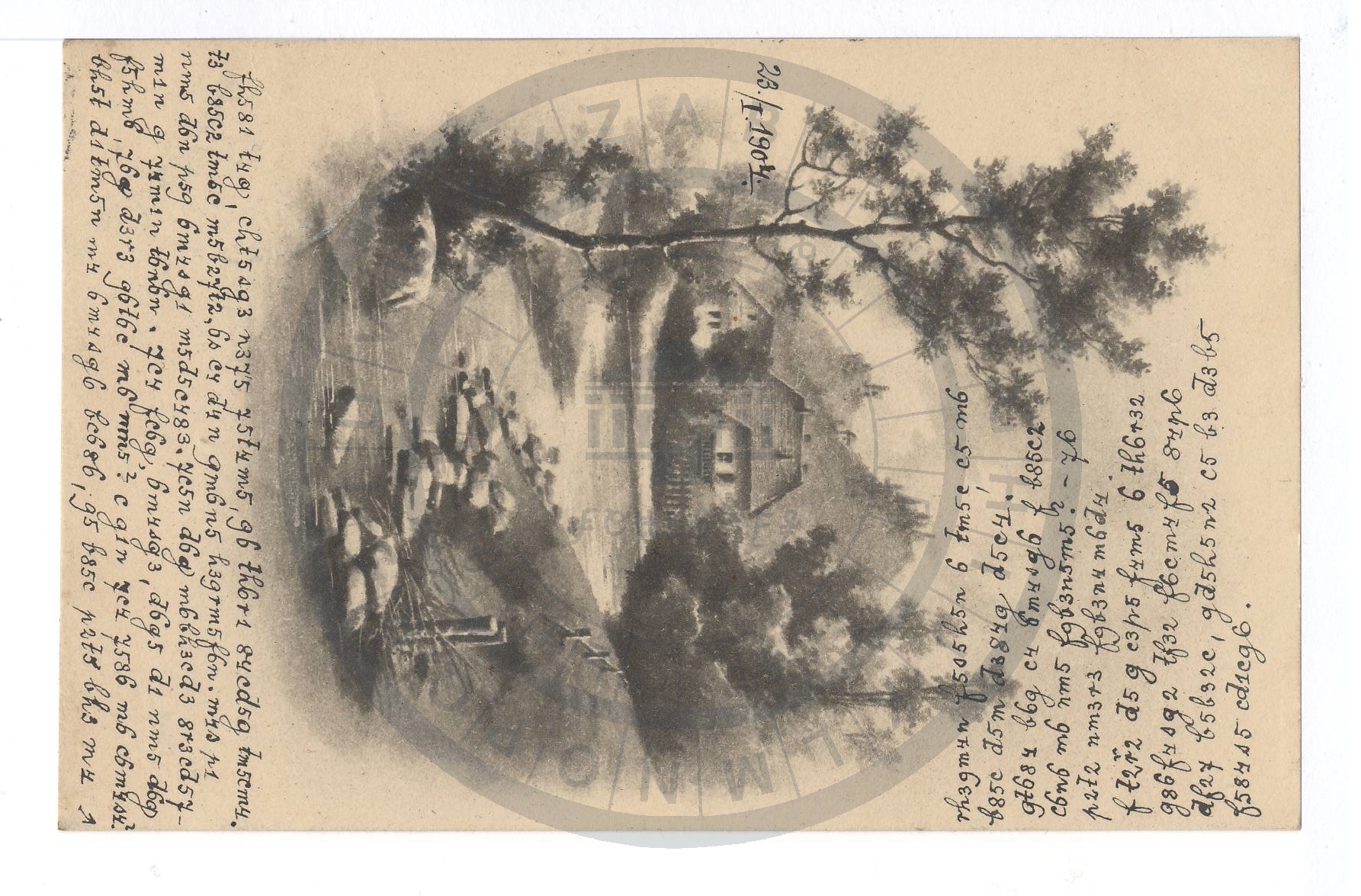
An editorial summary of the readable passages, rather than a complete translation of every sign. The sender remains unidentified; the nickname and similar language across cards do not establish a single writer.
The opening thanks an affectionately addressed sweetheart for today’s dear note. The writer says nothing there would please him without Anička and describes indifference to other ladies.
The line ?o plesu dnas nepuj?u probably says the writer will not attend a ball today, despite displeasing acquaintances. A blind Czech review favors d for the opening unknown, but retains p as an alternative; dnas also needs an already-assigned-letter repair to become dnes. The proposed meaning therefore is not a clean literal reading.
The partly resolved clause jsi vsak anicko take ty mne tak / vern? jak toho zadas na nne appears to ask whether Anička is as faithful as she expects the writer to be. Completing vern? and repairing nne are editorial conjectures. A later passage contrasts an earlier description of a ball as a terrible evening with present eagerness for it; ni, budo, hroznim and tllik remain anomalous in the saved output.
The direct question s kym jsi jela na sanici asks whom she went with. The Czech Language Institute’s SSJČ gives sleigh-riding or sledding as a sense of sanice, supporting that interpretation without replacing the literal word. The nearby “a week ago” refers most naturally to a note and does not securely date this outing.
The ending appears to describe embracing and kissing the addressee in imagination and missing her deeply. A proposed “dear little head” requires changing klavicku to hlavicku; the possessive dvou → tvou and the missing-you phrase to pe → tobe also require conjectural letter and spacing repairs. The literal signoff contains pepous. Pepouš is an editorial accented nickname, not a civil identification. The third-person verbs vine and liba can take the delayed subject “your Pepouš” and need not be rewritten into first person.
A retrospective comparison with card 199 is especially suggestive: card 200 asks s kym jsi jela na sanici, while card 199 says byl jsem zarliv na vasi sanici / dokud jsem nevedel s kym jsi jela, expressing jealousy until the companion was known. An apparent decision to miss a ball also fits card 199’s account of missing a Saturday ball. If the inscriptions date composition and card 199 means the immediately preceding Saturday, this points to 23 January. These are conditional inter-card correspondences, not independent event corroboration or proof of the same physical writer.
Saved literal readings
This is the saved decoding output. Question marks mark unresolved source units, which may be single letters, digraphs or uncertain groupings of strokes. Spelling defects, line breaks and source-region labels are preserved; proposed corrections are discussed separately.
First primary fixed-key literal (secondary output is identical)
vrely dik srdecko moje jedine za drahy listek dnesni
?o plesu dnas nepuj?u ac si tim zname rozhnevam nic by
mne tam bez anicky netesilo jsem tak naprosto lhostej
nym k j?nym damam jsi vsak anicko take ty mne tak
vern? jak toho zadas na nne s kym jsi jela na sanici
pred tydnem ni anicka psala ze ples budo pro ni
hroznim vecerem a dnes se na
ples ten tllik tesi
zdali pak si ?nicka v plasu
sama na mne v?pomene ja
budu mnoho v?pominati
v duchu te k sobe vine a drahou
klavicku dvou vasniv? liba
?vuj pepous kteremu se po to pe
velice styska
What remains uncertain
- Nine exact source unknowns remain at P045, P061, P139, P177, P301, P323, P342, P392 and P397. No new value or source repair has been applied to them.
- The tentative normalized Czech changes some already assigned letters as well as filling unknowns. Those conjectures do not increase measured decoding accuracy. Coverage and linguistic plausibility are different quantities.
- Neither card names or securely locates the ball or sleigh outing. Card 200’s speaker-side and addressee-side ball references need not concern one event; card 198’s later ball reference need not concern the same occasion either.
- Card 200 was selected after neighbouring readings were known. The chronology comparison is retrospective. Card 198’s existing reading is post-fit, not a fresh independent prediction.
Source and method
Unchanged 24-entry key after independent source transcriptions and source-only reconciliation. Selected deliberately as a chronological neighbour of cards 199 and 198, not as a random historical validation. No new assignments or linguistic repairs enter the first literal.
First fixed-key prediction: 424 of 433 source positions mapped; nine remain unknown. Coverage is 97.9%, not accuracy. Several assigned letters also remain linguistically anomalous. Secondary output is byte-identical.
HCPortal catalogue record for card 200
23 January 1904 · catalogue date; month reading uncertain. The date label records its evidence source; it does not establish a posting or receipt date.
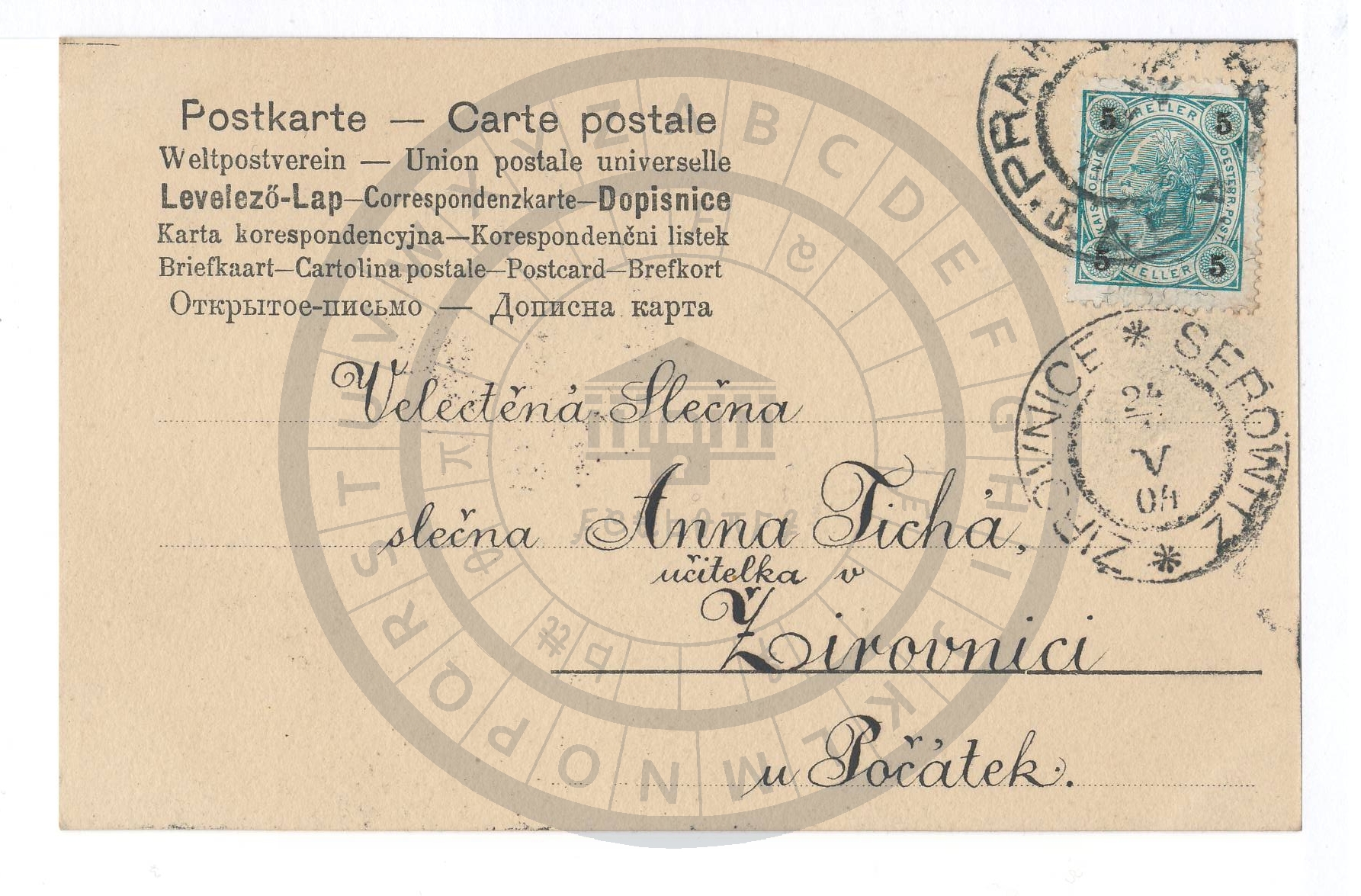
The source-only reverse review reads Anna Tichá, teacher in Žirovnice near Počátky. Day 23 and year 1904 have source support; the month is uncertain, with a 1/I-like reading offered by one reader. January remains the qualified catalogue normalization. The lower cancellation’s V has unresolved field function and is not evidence for a May date or a reconstructed postal route.
The unchanged key covers 424 of 433 graphical body positions and emits 425 letters because one mapped unit emits ch. Nine exact source identities remain unresolved. None meets the fixed criteria for applying the rules for marked signs, so the secondary result adds no letters and strict agreement for newly emitted secondary positions is non-estimable. A separate blind language review offers six unique high-confidence base-letter proposals but also flags several assigned-character anomalies. Its fluent reconstruction cannot replace the first literal.
The two recovered source drafts were preserved and independently checked before decoding. Their recovery does not establish when the original readers finished them.
The source transcriptions and language checks were AI-generated. No external human expert review is claimed. Coverage counts signs assigned a value, not verified correct letters; one sign can produce the two-letter Czech ch.
Evidence and context
- Original study: development and fixed-key testing
- First-edition partial key and staged mark rules
- Official HCPortal catalogue record: pc_hcp_200
- Official HCPortal picture and message-side source image
- Official HCPortal reverse and address-side source image
- Czech Language Institute SSJČ entry for sanice
- Card 199: later sleigh and Saturday-ball wording
- First primary literal — exact text download
Editorial revision, 5 October 2026: the explanation has been reorganized and repeated cautions shortened. Saved Czech outputs, numerical results and source links are unchanged. Photographs remain linked at their source.